Check Your Trees
HOUSE HOLDERS - CHECK YOUR TREES.
Ireland has a legacy of old trees that were planted over one hundred and fifty years ago by estate owners and farmers. These trees have served us well, providing much needed shelter and supplying us with some of the few woods that we have. Unfortunately, in our wet, windy climate, trees don't last forever; instead, they get old and rotten. We still have fewer trees than any other European country except Iceland and this means that responsible tree owners may be tempted to retain trees, sometimes beyond their safe life expectancy.
Owners of trees are required by law to ensure that their trees are reasonably safe and not a threat to the public. They are not necessarily expected to be tree experts; however, they should inspect their trees regularly and be able to spot the most obvious signs of danger. For example, a tree owner should know that the following symptoms are serious.
A tree is dead or dying. Once a tree dies, the internal systems that protect the wood from rot stop working. There is no way of telling how rotten the wood in a dead tree is, because the roots are most likely to rot first. Dead trees are mostly unsafe.
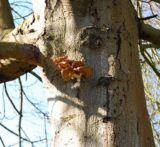
A tree has fungal brackets growing on it. By the time a wood rotting fungus has enough surplus energy to produce fruiting bodies, you can be sure that the wood its feeding on is rotten. Trees with fungal fruiting bodies growing on them are usually dangerous.
A tree is hollow, has cavities, or has lost a lot of bark. Again, part of the structure of the tree is no longer alive and is therefore considered weak. If you own a hollow tree, or one that has lost bark or has cavities, get advice from a competent Arboriculturalist.
There has been recent digging, close to the base of a tree, that has cut or killed the trees' roots. A big tree is anchored into more than four hundred tonnes of soil by a network of fine roots. These roots act as cables and keep the bigger roots near the trunk stable and solid in the ground. Luckily, trees can re-grow these cabling roots if they are cut, but, until that happens, the tree will not be as stable as it should be. If the roots of a mature tree have been cut get advice from a competent Arboriculturalist.
The tree has been badly damaged or has shifted in a gale. If you own a mature tree that has split or partly blown over in a recent gale you should consider it dangerous and get it cut down as quickly as possible.
Almost all injuries and deaths caused by trees occur to drivers or passengers in cars and it is the trees growing along the roads that must be particularly checked on a regular basis. Unfortunately, accidents involving trees form a surprisingly high proportion of those that cause serious injury or death on our roads.
If you do own trees, go out and look at them and don't put it off. If you think that you have a tree that looks dangerous and is growing in a place that puts people or property at risk, get a professional tree surgeon or Arboriculturalist to look at it. If they recommend that the tree be pruned or felled, make sure that the work is carried out as soon as possible. Always use a competent tree surgeon to remove trees and confirm that they are adequately insured; dangerous trees can be very dangerous to fell!
By no means all large trees are dangerous. If you own large trees and they are safe, enjoy them and protect them while they are safe. They will provide shelter and screening. If you have to fell trees, remember to plant new ones in their place. Ireland has still far too few trees and the more trees that we have, the less noticeable will be the removal of some venerable old tree that is, sadly, past its prime.
Check Your Trees
Advice Notes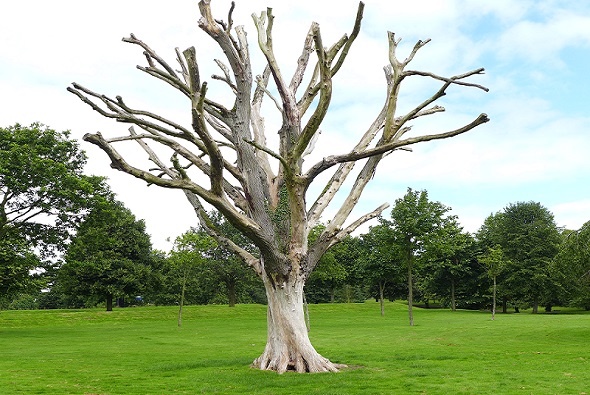
Managing the Risk from Trees Growing on Lands Owned or Controlled by Public Authorities
MANAGING THE RISK FROM TREES GROWING ON LANDS OWNED OR CONTROLLED BY PUBLIC AUTHORITIES Tree risk in Northern Ireland. Tree risk assessments are usually designed to deal with the danger of a tree or part of a tree failing. In Northern Ireland falling trees generally cause death or injury to occupants of cars and this represents a risk of about 1 in two million of the population in any year. Risks posed to pedestrians or occupants of houses are much lower, although the risk of damage by trees to property (particularly to low load bearing structures like sheds, fences and glasshouses) can be significant.
Table 1: The chances of an individual being killed or seriously injured in any one year by a tree in Northern Ireland (compiled by the Author)*
|
Behaviour |
Approximate Risk |
Comments |
|
Becoming a Tree Surgeon or climbing a tree |
1 in 900 |
Four deaths in the last fifteen years |
|
Crashing a car off a road |
1 in 60,000 |
Until recently, about thirty deaths per year |
|
Becoming depressed |
1 in 180,000 |
About ten suicides associated with trees per year |
|
Having a tree fall on you when driving |
1 in 1,940,000 |
Seven deaths in the last fifteen years |
|
Having a tree fall on you when walking |
1 in 40,000,000 |
Less than one death per year in the British Isles |
|
Being killed or injured by a tree while in a house |
1 in 150,000,000 |
About one death per year in Western Europe |
- Ensure that all tree surgeons appointed by them are competently trained and organised to safely carry out tree surgery operations
- Review all incidents of death or serious injury associated with trees growing on their property (including road traffic accidents and suicides) and react in a way that minimises future incidents.
- Establish, using a competent member of their own staff, a three tier priority system for zoning their trees, with high priority zones (within falling distance of car parks, roads, low load bearing structures, play areas and areas where non 'compos mentis' activity may occur), medium priority zones (within falling distance of busy or habitual pedestrian routes, adjoining gardens, high load bearing structures etc) and low priority zones (low or controlled pedestrian access, remote areas etc).
- Implement a three tier priority system for monitoring their trees, with informal observations of potential tree risk encouraged from members of their own staff, neighbours and the public, formal walk over surveys of all potentially dangerous trees carried out, at regular intervals, by dedicated members of their Grounds Maintenance staff and detailed inspections of high risk trees, carried out, at regular intervals, by a trained, competent professional.
- Provide training to their staff. In particular, a short (circ. half day) course on the identification of basic tree hazards should be made available to all permanent members of their Grounds Maintenance staff, with a more detailed (two to five day) course on tree inspections made available to those supervisors and managers tasked with completing the formal, walk over surveys.
Click here to download this article as a word document

Managing the Risk from Trees Growing on Lands Owned or Controlled by Public Authorities
Advice Notes
PROTECTING TREES DURING CONSTRUCTION
PROTECTING TREES DURING CONSTRUCTION
Trees are complex living organisms that require light, nutrients, water and oxygen to survive. Although trees can recover from physical damage, it usually takes many years for this to occur. During this time they are susceptible to infection by wood-rotting fungi and such infections can lead to crown or root plate instability and failure.
Trees have evolved into tall, well-designed structures that respond to lateral movement by growing thicker. The more lateral movement there is in a particular part of a tree, the thicker that part of the tree becomes. In this way trees spread the loads exerted on the tree by wind or gravity. InNorthern Irelandtree roots are generally found in the top 60cms of the soil and are restricted by the availability of oxygen. Those roots that are close enough to the trunk of the tree to experience movement when the wind blows get thicker and form the characteristic 'root plate' that acts as a foundation to support the tree. The other roots, further away from the tree, remain about 3cms in diameter and act as cables, spreading well away from the tree trunk, anchoring the root plate into the surrounding soil and stopping the tree from blowing over.
Construction works can have a significant detrimental effect on the health and stability of trees. These effects are usually caused either by direct mechanical damage to roots, trunks and branches or indirect damage through alterations or poisoning in the root zone.
BS5837:2012 Trees in Relation to Design, Demolition and Construction - Recommendations
This British Standard has been produced to provide guidelines for incorporating trees into proposed developments. It provides recommendations for base line tree surveys, mapping the crowns of trees and for the assessment of the relative importance of individual trees. The recommendations contained in BS 5837:2012 have been adopted by the NHBC (with extracts being included inAppendix4.2FBuildingnear trees) and inform Planning decisions.
One of the most significant features of this British Standard is its recommendation to create 'zones of protection' around trees to be retained. In these, an area around a tree, normally centred on the trunk of the tree, is protected from construction damage during development. This protection is ensured by the construction of a robust temporary fence as specified in Figures 2 and 3 of BS5837:2012
The recommendations contained in BS5837:2012 do allow some limited construction works to be carried out within the 'zone of protection' surrounding retained trees. The underlying principal of any works close to retained trees is that these works do not damage significant roots and that they do not change the root environment in a way that roots are killed. Excavations are often associated with root damage, while soil contamination, infilling or heavy plant movement is usually associated with root death.
The zone of protection around trees that is recommended in BS5837:2012 has been interpreted as defining the minimum amount of protection required to ensure that a tree is not 'damaged' during construction. This has important implications when such trees are protected by a Tree Preservation Order or by a Planning condition. Perhaps more significantly, adherence to the recommendations contained in BS 5837:2012 should ensure that no liability will attach to the architect, planner or construction company if a retained tree subsequently fails.
Selected References
NHBC Standards, Chapter 4.2 'Building near trees' is available from National House Building Council, Buildmark House,Chiltern Avenue, Amersham, Bucks HP6 5AP
BS 5837 : 2012 Trees in Relation to Design, Demolition and Construction - Recommendations is available from BSI

PROTECTING TREES DURING CONSTRUCTION
Advice Notes
TREE ROOTS AND FOUNDATIONS
TREE ROOTS AND FOUNDATIONS
Tree roots can cause damage to structures in two main ways
- Direct damage, where the thickening of the root causes movement and breakage
- In-direct damage associated with soil shrinkage or heave.
Indirect damage - background. Trees can remove water from within certain types of clay and organic particles in Soils. The removal of this water causes the particle to become smaller and thus allows a firmly consolidated soil to shrink. This can only occur on clay or organic soils and is always worst following very dry summers. The water that is lost from shrinkable soils is partly or completely replaced during wet winter weather. Alternate shrinking and heaving is characteristic of subsidence movement caused by trees. Subsidence will usually be worst nearest to the tree. In Northern Ireland subsidence damage caused by trees appears to be over reported. Detailed investigation often indicates other causes for the subsidence, such as inadequate foundations or un-consolidated material under the foundations. However, soils with a high plasticity index do occur in Northern Ireland and steps should be taken to reduce the risk of subsequent subsidence damage to buildings constructed on these soils.
Indirect damage - risk of subsidence. Tree roots may cause certain clay or organic soils to shrink during excessively dry weather.
Action - Establish the plasticity index of the underlying substrate (in line with guidelines given in BS1377 methods of test for soils for civil engineering purposes). If this is less than 10% the foundations should be adequately constructed on soils capable of supporting the imposed loads without excessive movement. If the plasticity index is greater than 10% the foundations should be designed by an Engineer, taking account of the recommendations given in Chapter 4.2 of the NHBC Standards 'Building near trees' and with advice from a competent Arboriculturalist.
Indirect damage - risk of heave. Heave occurs much more rarely than subsidence and is caused by soil particles that have been denuded of structural water by a nearby tree re-adsorbing water following the removal of that tree. Reported cases from England suggest that the risk of heave is associated with the removal of trees on development sites during or immediately following very dry weather.
Action - try to avoid site clearance during the summer or early autumn. Establish the plasticity index of the underlying substrate (in line with guidelines given in BS 1377 methods of test for soils for civil engineering purposes). If this is less than 10% the foundations should be adequately constructed on soils capable of supporting the imposed loads without excessive movement. If the plasticity index is greater than 10% the foundations should be designed by an Engineer, taking account of the recommendations given in Chapter 4.2 of the NHBC Standards 'Building near trees' and with advice from a competent Arboriculturalist.
Selected References
NHBC Standards, Chapter 4.2 'Building near trees' and available from National House Building Council,
Buildmark House, Chiltern Avenue, Amersham, Bucks HP6 5AP
BS 1377 Methods of test for soils for Civil Engineering purposes and available from HMSO
BS 5837 : 1991 Trees in Relation to Construction and available from HMSO
NJUG Publication No 10 'Guidelines for the planning, installation and maintenance of utility services in proximity to trees and available from the National Joint Utilities Group, 30 Millbank, London SW1P 4RD

TREE ROOTS AND FOUNDATIONS
Advice Notes
Managing Phytophthora
Managing Phytophthora cinnamomi
- Drainage. Small core samples of the soil around affected plants should be taken, using an augur or similar, to ensure that no water-logging is present within about 30cms from the soil surface. If water-logging is present (greying and a strong ‘septic tank’ smell) some drainage measures should be adopted. The principal aims of these drainage improvements should be to increase the depth of soil available for the roots of the trees and shrubs, and to reduce the potential of cross contamination. The subsoil under and around the bushes should be aerated to a depth of at least 50cms using injected compressed air.
- Irrigation. Although Phytophthora species thrive in wet or waterlogged conditions, the damage that they do to infected trees and shrubs make them very susceptible to water stress during dry conditions. Accordingly, some facility for irrigating affected bushes using tap water (ie water that has been treated to kill microbes) should be made available. Irrigation should only occur during periods when there is a significant soil moisture deficit and the treated water should be applied in a way that reduces this moisture deficit in the top 30cms of the soil profile without causing surface runoff.
- Soil fertility. Soil and leaf samples should be taken and analysed to establish the general nutritional status of the apparently healthy yew trees. Any nutritional in-balance should be addressed using an appropriate non-organic fertiliser.
- Mulches. Current research indicates that the provision of a wood chip mulch can give some protection from infection by Phytophthora spp. However, these mulches may also increase water-logging and thus favour Phytophthora infections. Accordingly, well-composted wood chip mulches may be applied around the base of these trees, but only when the drainage of the underlying soil is completely acceptable.
- Biostimulants and fungicides. Recent research (Gillan et al 2003) suggests that the use of biostimulants can increase root growth in a range of tree species. Accordingly the biostimulate 'Generate' should be applied to all trees showing reduced vigour in accordance with the manufacturers recommendations. Where existing trees are showing reduced growth, the fungicide Fosetyl-Al (Aliette WDG or similar) should be applied in accordance with the label recommendations.
Managing Phytophthora
Advice Notes
Direct Tree Root Damage
TREE ROOTS AND DIRECT DAMAGE TO STRUCTURES
Tree roots can cause damage to strutures in two main ways
- Direct damage, where the thickening of the root causes movement and breakage
- In-direct damage associated with soil shrinkage or heave.
Direct damage - background. In Northern Ireland tree roots are generally found in the top 60 cms of the soil and are restricted by the availability of oxygen in the soil. Tree roots are capable of auto engineering; that is they respond to lateral movement by growing thicker. In natural conditions, those roots that are close enough to the trunk of the tree to 'feel' movement when the wind blows get thicker and form the characteristic 'root plate' that acts as a base plate and foundation to support the tree. The other roots, further away from the tree, remain about 3.0 cms in diameter and act as cables, spreading well away from the tree trunk, tying the root plate into the surrounding soil and stopping the tree from blowing over.
Unfortunately, this ability to auto-engineer in roots means that any root that is subject to lateral movement will thicken. This is best seen in flowering cherries or poplars that are growing in lawns. The vibration of the lawnmower causes the tree roots nearest the lawn surface to thicken to the extent that they rise above the lawn surface and cause un-evenness. Similar processes can also cause problems on paved or tarred surfaces.
Direct Damage - structures. Lateral movement in tree roots causes these roots to grow thicker. This exerts pressure on surrounding structures and is strong enough to lift about 1.8 m of masonry. This sort of damage is usually confined to low load bearing structures such as kerbs, paving and low garden walls. It can also affect sunrooms, conservatories and porches.
Action - All foundations should be adequately constructed on soils capable of supporting the imposed loads without excessive movement and should be deep enough to preclude tree roots. Where this is not possible, tree roots should be covered with sharp sand and be bridged over with an adequately reinforced lintel or raft, well supported at each end.
Direct Damage - paved surfaces. Tree roots are susceptible to small lateral movements, such as those imposed by cars or even pedestrians. As affected roots thicken this can cause problems with un-evenness on paved surfaces near trees.
Action - Consider alternatives to paved surfaces, such as gravel or loose cobbles, or; Carefully remove accumulated organic material and loose soil, leaving existing topsoil in situ. Protect root zone with a layer of sharp sand and, on this, establish a firm sub-base of no-fines granular material supported on a geotextile membrane. Construct paved area on this sub-base using established design guidelines with a porous surface finish such as paviors or porous bitmac.
Selected references
NHBC Standards, Chapter 4.2 'Building near trees' and available from National House Building Council,
Buildmark House, Chiltern Avenue, Amersham, Bucks HP6 5AP
BS 1377 Methods of test for soils for Civil Engineering purposes and available from HMSO
BS 5837 : 2005 Trees in Relation to Construction and available from HMSO
NJUG Publication No 10 'Guidelines for the planning, installation and maintenance of utility services in proximity to trees and available from the National Joint Utilities Group, 30 Millbank, London SW1P 4RD